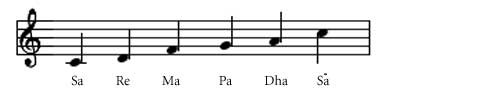
(general discussion of arohana) - (general discussion of notation)
Durga is a very popular late evening rag. However there is sometimes confusion. The confusion stems from the fact that an unrelated rag known as Madhuradhwani is also sometimes called Durga. In this page we will only be concerning ourself with the common form, and leave any discussion of Madhuradhwani for another time.
The name Durga is derived from the name of the goddess Amba or Parvati. She is the wife of Shiva, and is associated with great power. She is also referred to as "Ma Durga" or "Durga Mata", which means "Mother Durga". She is said to represent patience and fearlessness.
The origin of rag Durga is obscure. It has been suggested that this rag is derived from the south Indian Shuddha Saveri. This is certainly possible, for it is very common for North Indians to "borrow" rags from the South. But in such cases, they usually retain their south Indian names (e.g., Charukesi, Kalavati). Why would Durga acquire a new name?
We
must be open to the possibility that this scale may simply be a basic
part of the larger South Asian musical culture. It could have
been circulating for a long time, and when I mean long time, I mean
millennia. As such, it is possible that it was only recently
formalised by North Indian classical musicians. The close
relationship that Durga has
to other pentatonic rags (e.g., Malkauns, Bhupali),
coupled with the almost world-wide presence of these scales,
certainly means that it is a possibility. The structure is so
simple, and the harmonic relationship is so fundamental, that scales
with these intervals show up internationally, apparently with
independent origins.
Rag Durga is based upon Bilaval that. From this that, the Ga and Ni are omitted, therefore this is an audav rag.
Identification
of this rag in
lighter songs is sometimes difficult. This is because Durga is
linked to other common rags such
as Malkauns and Bhupali by
a
process known as murchchana.
Although this is not the time to go into the details of murchchanana,
let it suffice to say that if you take Durga and
start the
scale from Ma you get Bhupali.
Furthermore, if you take Durga and
start the scale from Dha, you get Malkauns.
The best way to keep these rags separate
is with a good clear drone;
this may be provided by the tanpura or
a similar source. Since such drones tend
to be missing in the lighter forms of music,
the distinction between
these rags is
occasionally obscured. One well known film
song in Durga is "Geet
Gaya Pattharon Ne".
It
is fairly easy to perform and compose in rag
Durga, because it does not share its
modality with any other north Indian rag.
Unlike the Bhupali/
Deshakar mode
which is very cramped and crowded, you do not have to worry too much
about Durga spilling
over into a different rag.
That being said,
there are some common phrases and a pakad which
makes Durga's the
character more identifiable.
This
is a very popular nocturnal melody which is also very sweet to listen
to. R
R m R; ,D ,D S clarifies
the Raag format. Though originally
from South Indian Classical Music,
this Raag is equally suitable for Hindustani Classical Music style.
Khayals and Bandishen and very nicely
composed and people practically
sway and dance to the melodic compositions. Pancham should not be a
resting note in Avroh.
This
Raag creates a very soothing atmosphere which is neither very deep
nor very playful. Following are the illustrative combinations
of this
Raag:
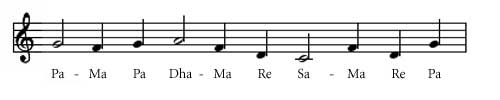
R m P D ; P D m ; m P D D m ; D m P D S' ; D D S' S' D D m; m P D ; m R ,D S;
Here is the basic form of Durga:
(general
discussion of arohana) - (general
discussion of notation)
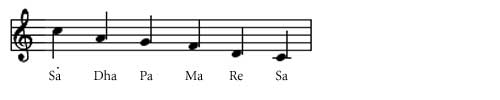
(general
discussion of avarohana)
Audav - (general discussion of jati)
Late Night - (general discussion of time and rag)
Bilawal that - (general discussion of that)
Raga
Durga is a late evening raga belonging to Bilawal Thaat. The
expression of Durga is the expression of
life, energy and joy. Not
used to express a 'purpose' it is sung to manifest the depth of
feeling of contentment.
Benefits:
1. Harmony
and Rejuvenation
2. Celebration &
Happiness
3. Compassion
4. Joy
5. Integration
6. Compassion
7.Boost
self-confidence and immunity